
THE CORRELATION BETWEEN MRS. DALLOWAY AND THE BELL JAR, IN CONTEXT OF NINA HAGENS’ BORN IN XIXAX

As a former depressed, poetry-writing teenager I quickly fell in to the beautifully deep dark hole that is Sylvia Plath’s body of work.
So, as I’m embarking on this writing project, I felt the need to start off at my humble beginnings.
And, as I am stuck in a loop of working to make a living, my forehead throbbing with pain, the muscle between my neck vertebra stuck, unable to move, my money spent on a massage to cure my workaholic lifestyle. Unable to get out of my head and this cycle– unable to write. I feel like I am a daughter of Woolf and Plath. A cycle developing and ever evolving.
Sylvia’s depression fueling my confused hormone filled, teenage brain.
Woolf’s mind fueling my exploding, migraine filled, early-twenties brain.
So, I start off with two book quotations.
“Only I wasn’t steering anything, not even myself. I just bumped from my hotel to work and to parties and from parties to my hotel and back to work like a numb trolleybus. I guess I should have been excited the way most of the other girls were, but I couldn’t get myself to react. I felt very still and very empty, the way the eye of a tornado must feel, moving dully along in the middle of the surrounding hullabaloo.” As I read this I relate to Esther, and Sylvia.

“But often now this body she wore (…), this body, with all its capacities, seemed nothing-nothing at all. She had the oddest sense of being herself invisible; unseen; unknown; there being no more marrying, no more having of children now, but only this astonishing and rather solemn progress with the rest of them, up Bond street, this being Mrs. Dalloway; not even Clarissa anymore; this being Mrs. Richard Dalloway. ” Clarissa Dalloway, Virginia Woolf.
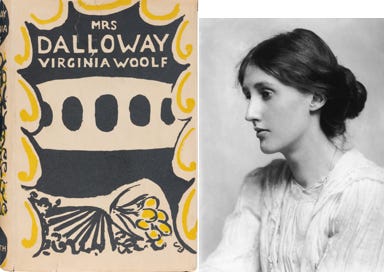
Sylvia Plath was an American feminist, poet and short-story writer from Boston. Known for struggling with her mental health, and, eventually committing suicide by putting her head in the oven. Children in the room next door. Today I am writing and thinking about her only novel, The Bell Jar. Written in 1963 short before her sad death.
Virginia Woolf was an English feminist, writer and poet known for being a member of The Bloomsbury Group. A group of young artists of all sorts in the early 1900s. Today I am writing about her 1925 novel Mrs. Dalloway.
These two novels were written almost half a century apart. Both time periods being pilasters, and a critical point in the development and rise of feminism. Similar themes and patterns, though very different time periods. Now living even half a century later, still encountering the same cycle.
As I was reading both novels, though almost 8 years of reading apart, I realized the feeling of stagnation I felt. How do I, as a woman living nearly a century away from Woolf still relate to the same social structures. I caught myself walking around town noticing people moving around me. Construction workers, street-dealers, business men, women with child.
Ever since I have been a cognizant human, I have had an extremely prominent stream of consciousness’-esque’ way of thinking, and babbling, and complaining. Not only to myself, but to others. Did Woolf experience this draining and pestering way of over-thinking/over-sharing too? Maybe, even so, did Plath?
The description of civilians is accurate and time specific, though beautifully relatable too, in both novels. The all-consuming thoughts of self, crowd the brain for Esther, though Clarissa’s thoughts are occupied with everything going on around her. It is impossible to say which is more tiring. Both writers are talented in disheartening ordinary day-to-day situations. Radicalizing the thoughts and feelings of maybe simple thinking pedestrians. Which is, in-all-likelihood, easier to do then to deal with your own issues. This is a concept I think is familiar to all of us.
Every day, I walk into a room of people presenting themselves, all the time. Parading, flaunting their artificial auras. All perpetuating this never-ending swirl of self-awareness, in combination with being overly aware of the other people attending the function.
I come bearing a happy go lucky mind set, and casual attitude, feeling superior to the people surrounding me. In a confident way. Not having the feeling of having to impress everyone, because I am not a part of that whole crowd. Me, I, walk swiftly and carelessly through a heavy-hearted sea of those trying to prove their worthiness, to others, but mostly– to themselves. I reflect inwards in times of over saturated crowds, and it graces me.
The way Sylvia talks about the famous men looking down upon Esther and Doreen for being foolish little small-town girls. The way Clarissa’s mad at her daughter for trying to find a way out of high society life. The way I feel aggression towards injustice.
The frozen cycle around society Clarissa faced.
Evolving to Esther’s claustrophobia around the expectations of her life, the breeches of the fig tree. The path Sylvia Plath struggled with was once laid down by the society of Virginia Woolf’s generation. Plath failing to break the mentally stable, modern woman role. Maybe, even because, a great woman like Woolf had already failed in trying to break it.
Alas, the pressure weighed them both down too much. Resulting in these smart, strong, talented women both taking their own life. I wonder what would have happened to them would they have been born into my life. My life, and, my generation. Would it be easier or would they have always had the same fate? Two women destined for ultimate greatness only after their death.
Making headway in to the cramped feelings, the immense pressure, I face as a woman who chooses to not live life the way my foremothers were forced to.
I wonder how I am different in perspective to Plath or Woolf. Have we really developed, as a society? Or are we completing the identical pattern as every calendar passes by. Are these two ground-breaking novels a factual representation of the system or too specific and anthropologic. As well as my current writings.
Are these themes of ‘identity-and-self’ egotistical in any way, or a good example for a certain type of person during that particular time period.
In The Bell Jar, Esther talks about having unhappy feelings towards a new phase in her life. A phase after college where a woman has to decide which path to take.
With this we recite a famous Plath metaphor.
“I saw my life branching out before me like the green fig tree in the story. From the tip of every branch, like a fat purple fig, a wonderful future beckoned and winked. One fig was a husband and a happy home and children, and another fig was a famous poet and another fig was a brilliant professor, and another fig was Ee Gee, the amazing editor, and another fig was Europe and Africa and South America, and another fig was Constantin and Socrates and Attila and a pack of other lovers with queer names and offbeat professions, and another fig was an Olympic lady crew champion, and beyond and above these figs were many more figs I couldn't quite make out. I saw myself sitting in the crotch of this fig tree, starving to death, just because I couldn't make up my mind which of the figs I would choose. I wanted each and every one of them, but choosing one meant losing all the rest, and, as I sat there, unable to decide, the figs began to wrinkle and go black, and, one by one, they plopped to the ground at my feet.”
The depressed state of mind we see Esther describe in The Bell Jar is very familiar to Plath. This novel is also known to be quite auto-biographical. As well as Mrs. Dalloway. Though Woolf pushed her personal struggle in to the character known as Septimus. And, the depression Woolf faced transformed into Septimus’ shell shock.
The main difference in manner of writing between these two books is Plath’s 1st person writing perspective, in perspective to, Woolf’s 3rd person writing perspective. This is what makes The Bell Jar feel more personal in context to Mrs. Dalloway. Therapeutically this also says a lot about, particularly, Woolf’s own character. Here follows a quote mentioning Septimus’ saddened state.
“Look, the unseen bade him, the voice which now communicated with him who was the greatest of mankind, Septimus, lately taken from life to death, the Lord who had come to renew society, who lay like a coverlet, a snow blanket smitten only by the sun, for ever unwasted, suffering for ever, the scapegoat, the eternal sufferer, but he did not want it, he moaned, putting from him with a wave of his hand that eternal suffering, that eternal loneliness.”
Another reoccurring theme in both novels is the complicated nature of female friendships. Both leading ladies have numerous girlfriends, and numerous differentiating feelings around them.
I can’t help myself from comparing Doreen to Sally Seton. Clarissa and Esther being both enamored and jealous of these women, maybe even in love. Virginia Woolf being notoriously bisexual. Doreen and Sally being both deemed liberated and unrestrained, breaking from a system of having to be a ‘good girl’ in order to achieve your spotless career path, and top place on the societal ladder.
Both writers eventually debunk this thought. Doreen being victim to many men taking advantage of her sexuality and free nature. Sally ending up in a rather unfortunate and standard marriage. There was even a kiss between Clarissa and Sally, a kiss that was never given the opportunity to grow into something more.
The description of both Sally and Doreen seems cryptically similar.
"She sat on the floor—that was her first impression of Sally—she sat on the floor with her arms round her knees, smoking a cigarette… It was an extraordinary beauty of the kind she most admired …a sort of abandonment, as if she could say anything, do anything… Sally went out, picked hollyhocks, dahlias—all sorts of flowers that had never been seen together—cut their heads off, and made them swim on the top of water in bowls. The effect was extraordinary… Indeed she did shock people" & “I wondered why I couldn't go the whole way doing what I should any more. This made me sad and tired. Then I wondered why I couldn't go the whole way doing what I shouldn't, the way Doreen did, and this made me even sadder and more tired.”
The societal pattern of jealousy and comparison between women, instead of support and admiration.
Two writers, navigating, examining, searching, looking in- and outwards. In order to live.
While I feel trapped in a system, within a system, unable to break the system, trying to break the system. I think about Nina Hagen, singing about literally being trapped in a system. A system, in a literal way, a system, behind a wall, living behind the Iron Curtain. Nina Hagen singing about a communist regime, previously known as the Soviet Union.
Thus, as I am writing this. I am listening to Nina Hagen’s ‘Born in Xixax’.
This is again radio Yerevan with our news (claps)
Oh, I'm sorry, got to turn on the machine
This is is radio Yerevan (laughs)
My name is Hans Ivanovich Hagen (laughs)
And this is the news (laughs)
I was born in XIXAX (oh la la la dee)
On my mama's farm
My father was a junkie
Und wir war'n sehr arm
My brother was a soldier (ooh)
By the war in Vietnam (shoot)
My uncle is a spy
In the Soviet Union
He knows that Mr. Brezhnev is planning a reunion
He knows that Mr. Brezhnev is planning a reunion
He knows that Mr. Brezhnev is planning a reunion
Well it's a big big big big secret (aum, aum, aum)
No no nobody understands except you I hope (Berlin)
Und eines Tages sind wir frei, einfach frei
One day we will be free, we will be free one day
One day we will be free, we will be free one day
One day we will be free, we-hee-hee we will be free
Well I believe in Jesus (ooh ooh ooh ooh)
I preach it loud and stark (oh)
Und Jackie, hallo (ooh ooh ooh ooh) (stupid Jacky)
Als er so bei mir lag (Jesus dwells)
Eto radio Yerevan, eto news (secret)
There's going to be a big disaster
(Nobody understands, you I hope)
Gonna be, world war number three
(Dennis, Tom)
Going to be a war or something, I know already
(Sigmund Freud, I confide)
I know it now already, I can feel it though already
Moscow's gonna become
(One day we will be free)
Washington's going to be number two
(We will be free one day)
Big big big big disaster's gonna come
(One day we will be free)
Come on, come on, come on dance to the end, let's do
Let's do, let's do 'er up, let's do her up
(One day we will be free)
He knows that Mr Brezhnev is planning a reunion
(Erump en nose)
He knows that Mr Brezhnev is planning a reunion
(Who knows)
He knows that Mr Brezhnev is planning a reunion
(Berlin, Berlin)
Lie, ah, stop the news (nyet, nyet)
(I wonder if I can make soup out of this)
Nyet super, nyet, ochen' plokho, nyet, nyet, nyet
Worship loco
https://www.goodreads.com/quotes/7511-i-saw-my-life-branching-out-before-me-like-the
https://www.goodreads.com/work/quotes/841320-mrs-dalloway?page=6